What Are CEFR Language Levels?
The Common European Framework of Reference for Languages (CEFR) is an internationally recognized system used to measure language ability. It provides a clear and structured way to describe how well someone can communicate in a language across four key skills: speaking, listening, reading, and writing.
Whether you are learning English, French, German, Spanish, or any other language, CEFR levels help you understand your current ability and set realistic learning goals. Today, the CEFR framework is widely used by language schools, universities, employers, and governments around the world.
At Lingua Learn Cambodia, all our language courses are aligned with CEFR standards, ensuring that you progress step by step with internationally recognized benchmarks.
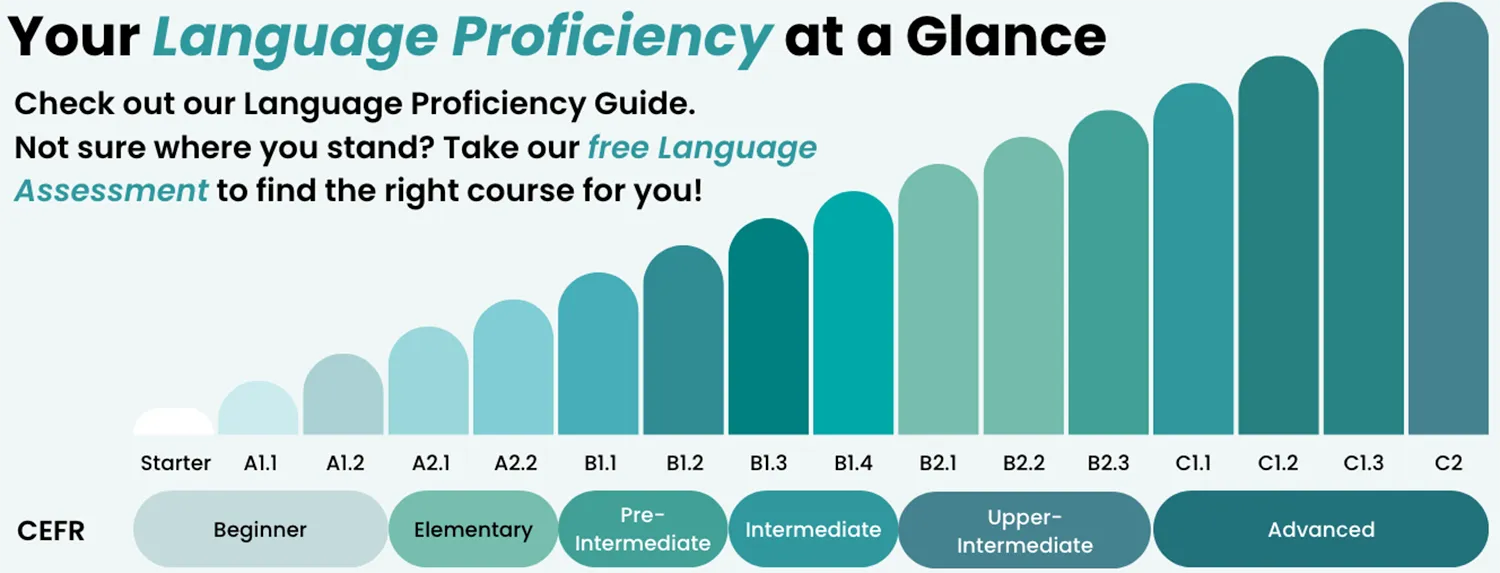
The 6 CEFR Levels Explained
The CEFR framework is divided into six levels, grouped into three main categories:
- A Levels (Basic User)
- B Levels (Independent User)
- C Levels (Proficient User)
Each level represents what a learner can do in real-life communication situations.
A1 – Beginner (Breakthrough)
At the A1 level, learners are just starting their language journey. You can understand and use simple everyday expressions and basic phrases.
You are able to:
- Introduce yourself and others
- Ask and answer simple questions (name, age, nationality)
- Use basic vocabulary for daily needs (food, directions, shopping)
Communication at this level is very limited and usually requires the other person to speak slowly and clearly.
A2 – Elementary (Waystage)
At A2, your confidence begins to grow. You can handle simple conversations in familiar situations.
You are able to:
- Talk about daily routines and activities
- Understand common expressions used in everyday life
- Communicate in simple and routine tasks
This level allows you to manage basic interactions such as ordering food, asking for directions, or talking about your background.
B1 – Intermediate (Threshold)
At B1, you become an independent user of the language. You can deal with most situations you may encounter while traveling or living abroad.
You are able to:
- Understand the main points of conversations on familiar topics
- Express opinions and describe experiences
- Write simple connected texts
This level is often considered the point where learners can function independently in everyday situations.
B2 – Upper Intermediate (Vantage)
At B2, you can communicate more fluently and confidently. You can interact with native speakers without too much difficulty.
You are able to:
- Understand complex texts and discussions
- Participate actively in conversations
- Express ideas clearly and in detail
Many employers and universities require a B2 level, as it shows you can work or study in the language effectively.
C1 – Advanced (Effective Proficiency)
At C1, you have a high level of fluency and can use the language flexibly in professional or academic contexts.
You are able to:
- Understand long and complex texts
- Express yourself fluently and spontaneously
- Use language effectively for work, study, and social purposes
This level is ideal for professionals, students, and anyone needing strong communication skills in a second language.
C2 – Proficient (Mastery)
C2 is the highest CEFR level and represents near-native proficiency.
You are able to:
- Understand almost everything you hear or read
- Summarize information from different sources
- Express yourself precisely and effortlessly
At this level, you can communicate with accuracy and nuance, even in complex or specialized situations.
Why Are CEFR Levels Important?
Understanding CEFR levels helps both learners and teachers in several ways:
- Clear learning goals – You always know what to focus on next
- Structured progression – Courses are organized step by step
- International recognition – Your level is understood worldwide
- Better course placement – You join the right class for your ability
CEFR levels are also commonly used to compare language exams such as IELTS or Cambridge English qualifications.
How Long Does It Take to Progress?
Language learning is a journey, and progress depends on your motivation, consistency, and exposure. Generally:
- A1 → A2: a few months
- A2 → B1: 3–6 months
- B1 → B2: 6–9 months
- B2 → C1+: longer-term commitment
With structured lessons, experienced teachers, and regular practice, you can move through the CEFR levels efficiently and confidently.
Learn Languages with CEFR at Lingua Learn Cambodia
At Lingua Learn Cambodia, our courses are carefully designed according to CEFR standards. Whether you are a complete beginner or an advanced learner, we will help you reach your goals step by step.
We offer:
- Flexible online and in-person classes
- Experienced international teachers
- Courses for adults, children, expats, and professionals
- Practical communication-focused learning
No matter your starting point, we will guide you from A1 to C2 with a clear and structured learning path.
Start Your Language Journey Today
Understanding your CEFR level is the first step toward success in language learning. If you are not sure about your current level, our team can help you assess it and recommend the best course for you.
👉 Contact us today and take the next step in your language journey with Lingua Learn Cambodia.
| CEFR Level | Skills | Typical Student Level |
|---|---|---|
| A1 – Beginner | Understand & use basic everyday expressions; introduce yourself; ask and answer simple questions. | Young beginners, early primary students, first-time adult learners. |
| A2 – Elementary | Understand sentences & common expressions; communicate in simple routine tasks. | Late primary or early secondary students; adults with 50–100 hours of study. |
| B1 – Intermediate | Understand main points on familiar topics; handle most travel situations; describe experiences & ambitions. | Secondary students or adults with 150–250 hours of study. |
| B2 – Upper-Intermediate | Understand complex texts; interact fluently; produce clear detailed text on various subjects. | High school or adult learners with 300–400 hours of study; ready for advanced courses. |
| C1 – Advanced | Understand demanding texts; recognize implicit meaning; express ideas fluently & flexibly. | University students, advanced adults, professional/academic learners (500+ hours). |
| C2 – Mastery | Understand virtually everything; summarize information; express ideas precisely & spontaneously. | Near-native proficiency; advanced university students, professionals, 1000+ hours of study. |